Showing posts with label safety. Show all posts

Tuesday, 6 September 2011

making lead weights the easy way

The evolution of the process of making cheap leads, lots, quickly.


You can purchase aluminium moulds but they have limitations, they are expensive and generally produce one or two at a time, they make 'professional looking' weights but it takes forever to make a batch of several dozen

Leads are not to be judged on their aesthetic properties but on their ability to give enough weight to cast a baited trace and to hold it on the bottom... so home made, rough and ready....and cheap.... leads will do the job.
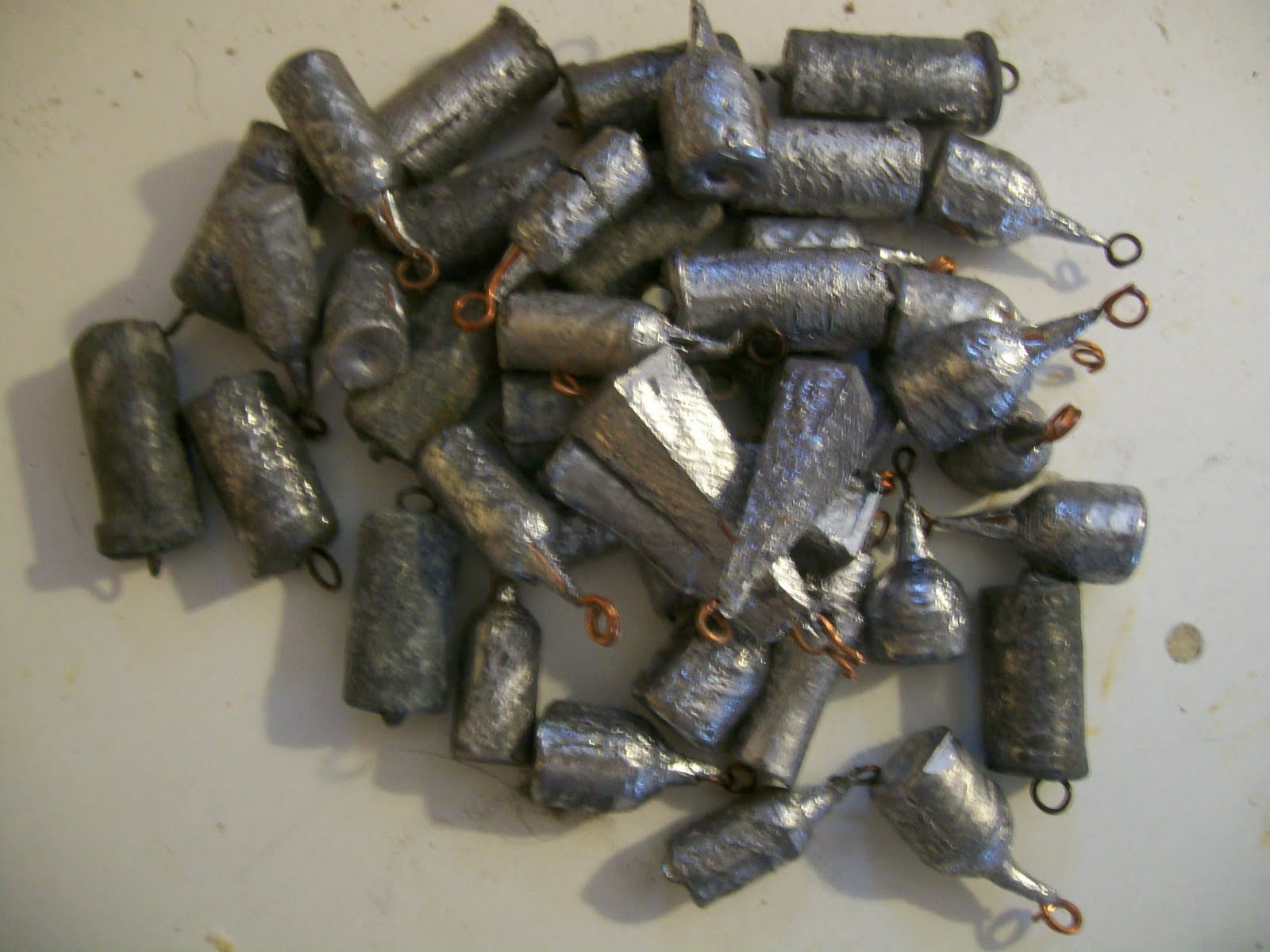
lead weights, cast in wooden moulds

Many years ago we decided to go fishing but had only a few weights and tackle shops were shut... so a quick think and the use of tools to hand resulted in the first 'cast in wood' weights.

Many people have told me that you cannot do this, 'the wood will catch fire', but you can.... and it doesn't. You will note in life that the 'you can't do that' types are the ones who haven't tried it.... and the 'yes you can' types are the ones who have.

A few minutes with a flat-bit in an electric drill drilling into pieces of timber, some copper wire stripped from an off-cut of electric cable and some lead melted in an aluminium milk saucepan with a blowlamp solved the problem. The holes were drilled with the wood on a concrete floor so the drill broke through the wood to give a small hole; twisted wires were put in the holes,the wood levelled up and the molten lead was poured into each hole. Some smoke ensued but no flames, so far, so good. When cool the wood was split open to reveal the leads, we made dozens of a three ounce version and they lasted us a good while, such is the nature of fishing that if you have plenty you seem to lose very few.
Somewhere I have a photograph, will add it when I find it.  update, have found one of the original leads


Now that species hunting has taken over most of my fishing I am once again turning to this way of making leads. Leads are consumable items and, although small one (28g) and two ounce (56g) weights are relatively cheap the losses during a session fishing in weedy or rocky places can put a dent in your wallet.

So, back to the wood, drills and a bit of thinking. The destruction of the simple mould each time was no real problem...the wood used was off-cuts of no value and twenty or thirty leads were made from each piece. Experiments since have shown that when cool the wood can be whacked down hard and the leads will emerge from the hole.... obviously the smoother the hole the more easily the lead will come out....it turns out that the more leads you make the more the wood chars until a layer is built up, this makes the extraction of the leads far easier and a couple of whacks soon shifts them.


one ounce lead, mould drilled with 9mm twist drill

The next session was to make some ounce leads, a 9mm twist drill was used this time and the holes drilled into a pair of pieces of 2" x 1" timber so that instead of splitting the wood the mould could be parted along the centreline and the mould reused...this worked well and many 1 oz ( about 30g) leads were made.
coke bottle shaped leads

Having the need of heavier weights, but having no bigger twist drill, the mould was modified by wiggling the drill from side to side to enlarge the hole, this resulted in some interestingly shaped 'coke bottle' leads. This enabled the production of loads of larger weights, 45 g , but at the cost of ruining the mould for making the smaller weights. It is a bit of a fiddle inserting the wires each time and reassembling the mould.... also the enlargement of the wire hole by constant use increased the risk of the molten lead escaping through the bottom of the mould; with the right sized hole the lead 'freezes' on contact with the copper wire and prevents any run out although there are gaps around the wire.

So the next stage was a re-think... put the wire loop in from the top ?


putting loops in from the top

Two lengths of 2" x 1" planed timber were drilled with a 16mm flat-bit, the lead poured into the holes and the twisted wire dangled into the molten lead on an aluminium nail placed across the hole and resting on the wood.
This worked well and the resulting lead of about two ounces has a sharp edge that grips into the sand or silt, they grip surprisingly well if you tighten the line...and will roll in the current if you don't.
These weights are fine for smooth ground fishing but snag on rough ground, as they are cheap to make that is not such a problem when using a rotten bottom ( attaching the lead with a lighter breaking strain line than your main line so that the lead is lost when it breaks rather than the rig or the hook-length with the fish on it. )

So it was thinking cap on again to make a lead with a smoother 'nose end' that would pull through weed without too much snagging.

pictures tells it all

An impending species hunting visit to the species rich snag pit of Hobb's Point made it necessary to come up with a better way.
To make a rounded nose the flat bit drill had to be made rounded, careful application of an angle grinder gave the required profile, the purchase of a pillar drill since making the other moulds gave the facility of drilling a smoother hole to an exact depth; the point of the drill could be brought to within a smidgeon of breaking though... a baiting needle the same diameter as the copper wire was pushed then through to make the final breakthrough.
Link16mm bit, 48g lead

12mm bit, 28g lead

Experience showed that the last holes were best not used as you need some spare at the end to whack onto a hard surface, as the copper wire is not doubled and twisted the leads come out fairly easily, and as said before, more use made for easier removal. The tails of copper wire are easily wrapped around a nail and trimmed with snips to make the loop ....although you will get sore fingers if you do 200 at a stretch....
The copper wire in this case is stripped from an old length of cooker wiring cable, scrounge some offcuts from an electrician or keep an eagle eye on builders skips.
The 12mm drill gave a weight of pretty near the ounce and the 16mm drill a weight of about an ounce and a half...

Trying to be clever........


I did take a tenon saw and chisel to pieces of wood to investigate making a tapered square section lead, it worked but I am unsure as to the benefits of that shape over the easier to produce round leads.... we will see............


The leads produced weighing 30g not bad for an estimate of 'about an ounce ( 28g)... good guesswork.


We will experiment further to see about making heavier weights at some time, obviously the bigger the lead the more heat has to be dissipated on cooling, this could mean the possibility of conflagration of the mould..... we will see...

Time for a disclaimer, we are sensible grown ups and suffered no death or even injury, we were careful to put plywood splash guards to protect against over enthusiastic filling, we had a bucket of water nearby to cool any burn sustained but kept all water away from the molten lead. We used an oven glove when holding the handle of the aluminium saucepan and added only dry lead to the melt..... and we worked outside in the fresh air to avoid being made crazy by the fumes from the lead.
I take no responsibility whatsoever for any harm that may befall you if you do something silly and hurt yourself or others after reading this.
Safety glasses would be a good idea as well as having immediate access to a bag of frozen peas... a burn will be far less of a problem if the heat is removed quickly from the affected area, cold water immediately then a frozen pack against it to quicken the cooling, common sense works better as you don't get burnt in the first place.


Sunday, 24 October 2010

North Devon, Ilfracombe Harbour

The top deck of the pier, note the tall post on the left on the lower deck.

Ilfracombe is on the north Devon coast, when you arrive you will note that the locals are not fond of direction signs.... there are small brown signs for The Aquarium and Harbour but they are easily missed. There is a large car park adjacent to the harbour wall so you can fish near to your car. There is a cheaper car park back at the head of the harbour.
There are toilets at the entrance to the car park and a tackle shop nearby, back up the road you came in on, follow the road round to the left and the shop is a short distance down that road on the right,
(Variety Sports, 23 Broad Street, Ilfracombe, Devon EX34 9EE). Note, Apr 2016, this shop looks as if it is closing down, for sale sign and irregular opening hours. There is another shop High Street Tackle, 153 High Street, Ilfracombe, Devon EX34 9EZ 
There are plenty of shops, cafés and pubs nearby for food and drink.

The lower deck at low tide.

The tides here are typical of the area, big. The water comes up a long way and can catch out the unwary..... the weed growing on the wooden posts on the lower level is a clue to what happens later in the tide. You can only fish the lower section for a couple of hours before and after low tide, less or not at all in rough weather.

This is a venue that can be fished with light or heavy tackle, big baits cast out towards Wales from the end of the lower level can catch you a conger, more likely to catch a dogfish, but conger are regularly caught here. Fishing light close in can result in many species that are attracted by the cover provided by the pier structure and submerged obstructions, it is snaggy however and you will lose some gear. Fish with hook lengths and lead links of lesser breaking strain than the mainline so that you can pull clear of the snags, fine wire hooks that bend such as the Mustad Nordic Bend are good in these situations. Size four are about right for general species hunting close in. Ragworm is the most used bait but fish baits will catch as well.
Fishing further out puts your bait out onto a generally sandy bottom with some weed clumps and other snags, there is not much tidal flow so grip leads are not necessary to hold bottom.
Float fishing near to the pier can be productive, when last there ( Mid October ), there were gar, sand smelt, coalfish and a mullet caught on fish strips fished at depths of up to twelve feet or so. Fishing out onto the sand gave small whiting, sole and a small conger eel

Tide flooding the lower level.

The pool that is enclosed by the pier can be fished; an angler fishing here had a silver eel later in the tide.


Note the post referred to in the first picture caption !

Fishing from the rocks is possible at low tide but be very aware of the advancing tide, the rocks in the picture above offer no refuge from a swell or a bigger tide.


Easy wheelchair access and no distance casting needed makes this a good venue for a disabled angler


easy level access to railed promenade on top level sloping ramp to un-railed lower level.


Thursday, 1 January 2009

Pembrokeshire, Milford Haven.


The Mackerel Landing

Milford Haven is on the north bank of a large natural harbour that serves the oil and gas industry. It is reached by the A4076 from Haverfordwest if travelling south or over the Cleddau Toll Bridge on the A477 from Pembroke Dock if heading west. The Marina is well signposted, at the bottom of a steepish hill you will need to turn back sharp left and follow that road until the junction where a right turn will get you onto the road along the containing wall of the dock. There is plenty of free parking alongside between the road and the wall.The venue is good for disabled access and fishing can be done from the back of a car along the sea wall or from a wheelchair on the Mackerel Landing ( so called as it was built to service the Russian ships that once worked the area hoovering up the shoals of fish).
There are signs saying no unauthorised access affixed to the landing, I have yet to see anyone take any notice of them..

Fishing from here is over fairly clean ground although you will lose some tackle to snags stones and seaweed. The yellow post with a cross on top, in the above picture under the middle of the sailing ship,marks a large cube of concrete ( 8' cube maybe ?) that will snag tackle. Legering fish or worm baits will get pout, codling, dogfish, eels, whiting, bass, pollack , wrasse and flatfish. In summer float fishing for mackerel and gar is the most popular method.


The sea wall provides a handy rod rest; although if you do this be aware that a bass is quite able to flip your rod over the wall. Fish can be caught right up to the wall so distance casting is not required.


The Lock Pit.

If there is no boat traffic you can fish into the lock pit for mini-species or if you are optimistic a conger eel. Bait and tackle can be obtained from Anglers Corner which is on Pill Road, on your left and visible from the main road if coming in from Haverfordwest. ( opposite junction with Coombs Drive...... tel 01645 698899).
There are no facilities at this venue, there is a Tesco supermarket not far from where you turned off the road to skirt around the marina
and some bars and cafés have appeared in the new buildings that have sprung up around the marina.
If you are prepared to put in the effort, soft or peeler crabs can be found on the beach to the left, seek them out among the weed covered rocks but put the stones back how you found them if you move them.


Monday, 12 May 2008

Lure fishing, spinning and feathering.

a selection of lures.

When fishing with a lure the intention is to fool a predatory fish that your lure is a small fish, and therefore edible. Most lures have a bright reflective surface to flash in the water imitating the flash of light on a fishes scales, the lure is shaped to move about in the water on retrieve the motion giving vibrations that the predator will mistake for the movement of a prey fish.
Lure fishing is done with a lighter rod than that used for 'beachcasting' unless you count 'mackerel bashing' with feathers as fishing. Feathering refers to casting out a string (or set) of 'feathers'. Once they were white chicken feathers whipped onto a hook, now they are likely to be made up with metallic tinsel, beads or plastic mini-fish rather than feathers. The feathers are attached to the mainline, a suitable casting weight added to the end and the whole lot cast out toward the horizon. The feathers are then allowed to sink for a predetermined time and then retrieved using a 'sink and draw' action. Assuming you are facing the sea and your feathers are fluttering down though the sea, pull the rod around to the side causing the feathers to 'dash' towards you, let the feathers flutter down again as you move the rod back to point to the sea whilst winding in the slack caused by the pull you have just done........repeat until the feathers are back with you. Very often the fish will hit the feathers as they sink, not on the pull. repeat the exercise until bored, tired out or you have enough mackerel for your needs. There is a knack to the technique, sometimes the shoal is working near the surface and a quick retrieve is used to keep the feathers up near the surface, not allowing them to sink too far; at other times the fish may be deep hence the need to count down the initial drop time allowed so that you can replicate the cast if you hit the shoal and catch fish. The cunning angler will laze about until others start catching nearby, then leap into action having noted the distance and drop time used by his more energetic neighbour. If you catch mackerel keep them cool ! People catch dozens, scores, even hundreds, put them in a plastic bag in the sun and carry home mushy fish that have already started to decompose. Take a cool box or bag with freezer blocks or frozen plastic bottles of squash or fruit juice, (delicious and refreshing as they thaw out ). Take only as many as you realistically need. Please don't catch them just for fun, if you handle the mackerel to unhook it and throw it back it will probably die due to the damage your hand or cloth has done to its scales and skin.
Use a shock leader when feathering to prevent a snap-off and to avoid maiming those near you. A shock leader is a length of heavier line about 7 to 10 times the numbers of ounces of the weight you use in pounds breaking strain. For example 4oz weight, 30 to 40 lb line; the line should be long enough to give you say 8' hanging from the end of the rod and half a dozen turns around your reel.

If you need some fresh bait quickly then feathering has a place, it is not sporting. To enjoy catching mackerel, catch them one at a time; use a lighter rod an ounce or two of lead depending on the casting weight of your rod and a spinner, artificial eel or a wedge, (see illustration above.) The spinners and wedges come in various casting weights and sizes although you can use a light spinner on a three foot long trace and put a drilled bullet weight on your mainline to give you the required casting weight and therefore the range you need. The sink and draw technique can be used or a steady reel in, although when reeling changing the retrieve speed gives the impression of a wounded fish and can increase your success rate; keep working the lure right to the waters edge, the fish will chase the lure right to the beach and I have seen mackerel take a lure as it starts up the shingle, right out of the water.
Fish other than mackerel of course will take a lure, pollack, gar, scad, and bass are regularly taken by this technique, use small feathers and you may catch herring be aware that the line these are tied with is not suitable for hard casting, you will need to cut back on you casting weight..
Loosing spinners and wedges can be expensive, a cheap and effective method is to just use a strip of mackerel or gar, the shiny belly bits are best, hook it once through one end (or as shown here) and use it with a ball weight as described earlier. Sandeels can be fished this way although I find that whipping them on with bait elastic is worthwhile.

Feathering is quite rightly banned on most piers for safety reasons, spinning should only be done if you have sufficient space around you to safely cast. Many piers and structures are too high above the water to spin effectively as the angle of retrieve brings the lure to the surface too quickly.
In rocky weedy areas a spinner or wedge is an expensive way of finding the rocks or weeds, in these circumstances use a shallow acting popper lure and the help of someone with you to show you the technique as it can't really be learned from reading about it.


Monday, 11 June 2007

The Solent, Taddiford Gap.

Taddiford Gap, view from the top of the cliff.


Taddiford Gap is a location reached via the A3058 between New Milton and Milford on Sea. There is a pay and display car park in a small valley on the seaward side of the road, it is easy to miss. There is a lay-by towards Milford where you could park for free but there is already quite a walk (about 400 yards) along a level path to the beach from the car park. There are no toilets of any other facilities nearby.
There is a climb down to the beach which is easy enough when the ground is dry. Do not even think about climbing down during or after periods of heavy rain....

Taddiford Gap, dangerous unstable soil slips.

As can be seen from the picture above the soil is clay and sand and is soft and unstable after heavy rain; sections slump and ooze onto the shingle beach. A further feature that may be off-putting is the fact that the area to the west of the access point is much favoured by nudists, especially gay nudists.
The beach is sheltered from northerly winds and is pleasant to fish, looking as it does out across to The Needles. The ground is generally clean sand and shingle. Species caught here are the usual for this stretch of coast, sole and small turbot are quite commonly caught here along with smoothound at times. Mackerel and gar show up on some tides and it is always worth casting a large bait in close for a bass. Light gear can be used as casting distance is not really important, ragworm, squid, sandeels and mackerel all catch fish here.
The nearest tackle and bait shop is Loni's Angling Centre at 119-123 Old Milton Road which is off the A337 towards New Milton or if travelling via Christchurch, Davis Tackle at Bargates.

Monday, 4 June 2007

The Purbecks.

Durlston Bay, looking west; the start of the Purbecks


The Purbecks is the name given to the area of Dorset from Swanage towards Weymouth. The marks along this stretch of coast are characterised by two things, rocky rough ground and long walks. The scenery and quiet solitude of the marks make the walks worthwhile.
Marks along this stretch are Durlston Bay, Tillywhim Caves, Dancing Ledge, Chapmans Pool, Warbarrow Bay, Kimmeridge Bay and Lulworth Cove.
Warbarrow Bay.

Sections of the coast fall within the military firing ranges. Be aware of the danger, notices and red flags indicate the danger area and firing times. Climbing down to the sea is not a good idea unless you are properly equipped for the task, a great many of call-outs for the Swanage Lifeboat crew are to rescue walkers, climbers and anglers trapped at the cliff base.
Few of the marks along this stretch of coast are suitable for young children, Worbarrow is fine, but others require long walks and often,when you get there slippery rocks high above other rocks or water; these are seldom good places for children.
I do not do long walks or rock fishing so any advice on the rocky marks, if added, will be second-hand information
.

The Purbecks, Worbarrow Bay.

Worbarrow Tout, tout is an old word for a lookout point

Worbarrow Bay is south west of Wareham and west of Swanage, it is within a military firing range area and entry times are dependent on range use. The access is usually given at weekends and bank holidays. Notices giving information are on the approach roads along with closing times for car parks. The area was requisitioned during WWII and has changed little since then so there is little or no new building and the area is farmed much as it was in the 1940s; it is a beautiful piece of countryside. Paths are marked by yellow topped posts.... stay on the paths !... if you are stupid enough to leave the paths, the metal objects looking like shells or bombs probably are and will cause you no good at all if they are poked or prodded.
There is a large car park, open from about 6am to 10pm, for which there is a charge of £2 (I think) to be paid into the honesty box. There are toilets on the left after the bridge over a small stream as you turn right to begin the long walk down to the bay. The walk down between trees and grassland is gently sloping until you reach the low cliff by the Tout where it becomes steep. The first part of the beach is sandy and you will be casting onto rough ground for wrasse bass or pollack. If spinning is you preferred method or fishing then make your way left out around the rocky area below the Tout.

Warbarrow Bay, looking west.

To the west the shingle beach becomes steeper and gives way to much deeper water and a cleaner bottom. Flatfish, rays, eels and other bottom feeding fish can be targeted here along with pollack, mackerel, gar and scad to float-fished sandeel or fish strip.. Ragworm will catch most fish here with mackerel or squid as backup or as a tipping bait.The sandy area is most crowded with other beach users so a walk out to the west is recommended to get away from the stone-chuckers, moored boats and swimmers.
The nearest tackle and bait shops are in Wareham, on the right just before the bridge over the River Frome as you leave the town towards Swanage or at Swanage.


Monday, 14 May 2007

Pembrokeshire, Stackpole Quay and Barafundle.

Stackpole Quay at very low tide.

Stackpole Quay is a tiny picturesque inlet on the rocky coast south of Pembroke. It is reached via the A4319 and then narrow lanes, the Stackpole Estate is National Trust Property, there is a large car park with toilet facilities and a cafe/restuarant which is open during the summer season. NT members have free parking, others have to pay. Access to the Quay and rocks is along a winding path with a final descent over the rock platforms. There is a steel escape ladder structure in the corner of the inlet for those silly enough to get trapped by the tide.
From the cliff top to the left of the Quay.

As can be seen from the photographs, this is rocky, snaggy country ! Fishing is best done by float fishing fish strips or sand eel or spinning. Bottom fished baits close to the rocks will get wrasse and pollack. Most fishing is done in summertime for mackerel and bass.
Low tide, showing rocks that you will fish over at high.

Hardy and agile types can find rock ledges to fish from by exploring the cliffs from the path that leads from the right of the harbour. This is not to be advised for children at any time or anyone at all in rough weather. Bottom fishing from these ledges needs a good cast to clear the rock ledges and kelp which eat tackle, bull huss are the prime target.
Those of more lazy disposition will find the beach at Barafundle more to their taste. A short walk and steepish climb down from the cliff path. Fishing here is mainly done from the rock fringes of the beach.


to be continued.

Sunday, 15 April 2007

Pembrokeshire, St Dogmaels

Teifi estuary, St Dogmaels low tide looking seaward.
Take the road from Cardigan to Poppit Sands, the B4536, in the village of St Dogmaels turn right and at the bottom of the hill there is a low sea wall. There is a small amount of roadside parking at the far end of the wall towards a new boat park. You can get access to the beach near the small pumping station or via the slipway further up the road. There are boat moorings here which make fishing difficult except at low tide, the beach here is muddy. Walk to the left towards the sea, past the boat moorings and where the estuary narrows a little and where the rocky bank starts, two channels of the estuary meet. The beach is firmer sandy silt here.This is a good mark for flounder fishing, my only ever near 3lb fish came from here to a soft crab bait tipped with mackerel. If you look you may find soft or peeler crab bait nearby although flounder will take fish baits, especially the larger fish. Locals used to use earthworms here with great success.
On big tides there is a lot of water moving in the estuary and the current is too strong for easy fishing at maximum flow, especially if the river is in spate. You will need to fish over low or high water slack times or when the flow abates. On very high tides it is possible to get cut off at this mark so consult tide tables before heading out there.
Bait is a problem in West Wales. Mackerel or frozen raw prawns can usually be bought from Tesco in Cardigan, there is a tackle shop in Cardigan (Castaway Tackle Shop in College Row 01239 621856 ) which sells frozen bait and very expensive farmed, boxed ragworm. As you go through the High Street on the one-way system you will notice a small square with what used to be Woolworths to the right, immediately turn left down the hill, this is College Row, there is a car park about 50 yards further on
.


Pembrokeshire, Newport Bridge and Estuary.

from the bridge looking seaward, low tide.

The estuary at Newport contains some large flounders that swim up into the estuary to feed on the mudflats. Bass, mullet, eels and sea trout (sewin) also can be caught although it is illegal to fish for sea trout or salmon without a license. The photograph shows the channels of deeper water. it is worth walking down the estuary on the eastern bank (golf course side) of the estuary to note the bends and gullies. At certain times during the flood or ebb tide there will be strong currents in the deep water channels and, if there has been rain recently, a lot of weed and debris in the water which will make fishing difficult. There is a spot just past the second white cottage, the one between the path and the water, which looks a good spot; I have not fished here though so cannot say what it fishes like. If I can get the time and worm or crab bait I will give it a go and edit this post accordingly.
Do not be tempted to walk far out onto the mudflats, it is gooey sticky (and deep) stuff. Peeler or soft crabs can be found in the intertidal zone if you are lucky.
Mullet can be targetted by float fishing bread or mackerel flesh at slack water over high tide or on the tide ebb tide when an overdepth set up can be trotted down the flow to target flounder and bass as well as the mullet. If you can get near the water level a spinner may take mullet bass or flounder.

Pembrokeshire, Cwm-yr-Eglwys


Cwm-yr-Eglwys, view from churchyard wall

Cwm-yr-Eglwys is a tiny bay on the east side of Dinas which is between Fishguard and Newport on the A487. Turn left as you leave the village of Dinas Cross and follow the narrow lane down to the end. Parking is straight ahead and is 'pay the attendant' or use the honesty box, it is cheap, only a few pounds pound per day, so please play the game. There are toilets near the car park behind the boat park but no other facilities. You can fish from the beach but over high tide on bigger tides you will need to retreat to fish from the wall of the churchyard. The churchyard has the remains of the church, most of which was washed away in the great "Royal Charter Storm" in 1859. On a sunny summer evening it would be difficult to imagine a nicer spot to fish, the fishing's not always good, the location makes up for it.

Dogfish roam the bay in large numbers at night along with some pollack, flatfish such as flounders, plaice and dabs are caught along with other species such as bass, gurnard, whiting and pouting. Squid and fish baits will catch most species here if you cannot get ragworm.


If you look carefully at the photograph above you will see a concrete platform that leads out onto flat topped rocks, there is space for a few people to fish from here either casting out diagonally into the centre of the bay or to use very light tackle to catch blennies and other small species that lurk under the rock ledges. If calm you could try float fishing for pollack,bass or mackerel in season.
Access to the rocks and concrete platform is cut off at high tide; there is a way back over both concrete areas and along a narrow path which is the top of the sea wall and can be seen below the white wall; cross over the stream and you will find a rough path leading back up to the lane.

the wall looking back from the concrete platform
Comfort indeed on the churchyard wall, benches to sit on, and all a short walk from the car park and the toilets. I noticed when I was last here ( in August 2010 ) there was an ice cream van, that also did hot and cold drinks, parked during the daytime in the entrance to the boat park between the car park and the churchyard.


The beach with the headland to the left.


On fine summer evenings you will see a procession of hopefuls negotiating the rocks to the left of the bay on their way out to the headland where deeper water means easy float fishing for mackerel, bass and pollack. Try mackerel strip or sand eel as bait but pollack are especially partial to a ragworm, hook it just once through the head. The access is rough and is not suitable for children.

If you fancy a pleasant walk you can head west along a level path around the back of "the Island" which takes you to Pwllgwaelod beach which is a sandy bay with rocky fringes. Pwllgwaelod gets very crowded, there is a pub/restaurant there.

The beach here gets very crowded during sunny summer days, leave the fishing until evening when the swimmers have left...... or get up early.

Ragworm is stocked sometimes, phone to check/order, by the shop in Cardigan (Castaway Tackle Shop in College Row 01239 621856 ); it is expensive farmed, boxed ragworm. Tesco in Cardigan sell mackerel and frozen raw prawns which make excellent bait.sliced into slivers on small hooks for smaller fish or used whole on a 1/0 or 2/0 hook for bass....or more likely a dogfish.


. from churchyard wall over high tide or, with a suitable wheelchair, from the firm sand beach.


Tuesday, 10 April 2007

Bristol Channel, Blue Anchor.

Blue Anchor, Looking east.

The area known as Blue Anchor takes its quaint name from the pub at the Watchet end of the beach. It is a high tide mark and can be found on the back road from Watchet to Minehead. It is fishable for a few hours either side of high water from the sea wall or the beach to the west. There is car parking on the landward side of the road or alongside the seaward side of the road for much of the venue. There are only a few places where there is access to the beach so fish have to be retrieved by use of a drop net, risking a loss by lifting the fish up by hand-lining or 'walking' the fish along the wall to an access spot. A large portion of the wall is unfishable due to the rock armour placed under the wall, this makes it next to impossible to land a fish.
Blue Anchor Beach, east towards 'Broken Wall'

A good selection of species can be caught from the wall or from the beach. Dogfish seem to be ever present with cod and whiting in the winter. Large conger eels are quite common; also taken are pouting, thornback rays, small eyed rays, bass and rockling. Small turbot sometimes put in an appearance. Baits used here are ragworm or lugworm , squid and fishbaits, ( if you are feeling energetic it is possible to dig lugworm from the beach ), sensible people buy them from Westcoast Angling in Watchet, ( 53 Swain Street TA23 0AG Tel: 01984 634807) or Minehead ( a kiosk on the harbour wall ) . There is a shop and café just inside the entrance to the caravan park which sells frozen bait and has a selection of basic tackle bits and pieces.
There is a toilet block about halfway along the bay and a café at the western end where there is also a station serving the steam railway.
At the eastern end of the beach there are some reefs which are exposed at low water; the locals who are aware of the dangers, local weather conditions and tides fish these reefs. Do not attempt to fish here, there is a real danger of drowning. Near the reefs are patches of soft sinking sand which are dangerous enough before you get out onto the rocks.


updated 17th August 2010


from wall only


Friday, 23 March 2007

Crabbing, Crab species.


A common shore crab.

If you go crabbing then the shore crab is the crab you are most likely to catch, its colour varies from brown, green and sometimes orange or red. The crab changes its shell periodically as it grows; the shell does not grow so the crab sheds it and grows another. If the crab is just ready to pop off its old shell it is called a peeler crab ( because you can peel off the shell and the leg coverings). Peeler crabs make good bait for most species of fish, they usually hide under stones and weed at this stage as they are vulnerable to predators. When the shell comes off there is a short period before the new shell hardens, the crab is now a softy or jelly crab and is also excellent bait. You are not likely to catch peeler or soft crabs, you have to hunt them out at low tide. Wrasse and other fish will eat hardback crabs with no bother, some cod are found to be stuffed with them when gutted.


A Velvet Swimming Crab.

As you can see, the Velvet Swimming Crab is a much more handsome fellow than the shore crab. It is covered in a velvet coat that catches the sunlight to make varying colours. The legs are flattened as an adaption to help it swim in the water. These are not as common as the shore crab but they nip just as hard, and they are usually very aggressive...
Stage one in picking up a crab.

Use your index finger to press firmly enough on the crab to stop it scuttling away. Not too hard or you will damage the crab.
Stage two in picking up a crab.

Having got the crab pinned down, place your middle finger and thumb on opposite sides of the shell and pick the crab up. He cannot get at you; if you are a child you can now terrorise little sisters, mothers, grannies etc with the crab, but remember it is a living creature, not a toy. Don't harm it and put it in a bucket and/or put it back in the sea at the end of your crabbing expedition.

Spider crab

This spider crab is about 40cm across and they grow much bigger, you will need a big bucket to keep these in. This example has lost a claw, this is quite common, it will grow a new one eventually. Spider crabs are vey docile compared with other crabs. The shell is spikey and uncomfortable to hold. Spider crabs nip off hooks and make bottom fishing nearly impossible during the summer along large stretches of the south coast. They are edible, most are exported to the continent if caught commercially.


Squat Lobster (Munida rugosa)

You may find a funny looking crab-like creature with very long claws and long antennae, this is the squat lobster. These grow a body about 10cm long but you are likely to catch specimens very much smaller.

.Hermit Crab

The Hermit Crab does not bother to make a shell on its body, it makes a home in a suitably sized whelk shell or similar and must find a bigger shell at intervals as he grows out of each shell. The crab will draw himself right back into the shell using his armoured claws as a defence. This crab makes a top bait for many larger species of fish and for this purpose can be removed easily from its shell by immersing it in fresh water.

There is another common crab, the Edible crab, when I can catch one in a drop net I will post a photograph.

.

Wednesday, 21 March 2007

Chesil Beach, Abbotsbury.


Abbotsbury, looking east towards Portland.

The beach at Abbotsbury is a nationally recognised mark, all manner of fish are caught here and it can get crowded when there are cod around in winter or mackerel in the summer..
Turn off the coast road from Weymouth to Bridport ( B3157) on a bend at the bottom of a steep hill that is signposted to the Subtropical Gardens. Go past the gardens and car parks to the end of the lane, there is a car park on your left. An attendant will take money from you in the tourist season but not in winter. There is a toilet block in the car park. Access to the beach is made easier by the boarded walkway to the crest of the bank, after this it is loose shingle; the beach is quite steeply banked and gives access to deep water.
Abbotsbury Beach, looking west.

Experienced anglers tend to trudge off towards the cottages to the west or The Dragon's Teeth to the east. The dragons teeth are a line of shaped concrete anti-tank blocks that remain from WWII. Debate rages whether the fishing is much better but at least you do not have mackerel feathers, hooks and leads whizzing around. You will be fishing onto clean, mainly snag free ground and you can fish fairly light in summer.
The Dragon's Teeth are just visible above the trees in the right foreground.
Shops and cafés are about a mile along the road in the village of Abbotsbury, There is a Swannery to see at Abbotsbury if you get bored with fishing. The nearest tackle shop is Weymouth Angling near the Town Bridge. If you are travelling here from the west then pick up bait in West Bay.
The usual Chesil comment applies here.....
do not even think about going onto the beach to fish with a big sea running